


The Latest

Editorials by the Skipper

How to Run a Sustainable Life Insurance Business (and Sleep at Night)

How to Run a Sustainable Life Insurance Business (and Sleep at Night)

Most IMOs will teach you how to sell. They’ll show you how to close, handle objections, and maybe even how to recruit. But very few will sit you down and teach you how to run your business like… a business.

And here’s the truth: without the right systems in place, every time something goes wrong—commissions get delayed, a big chargeback hits, or leads slow down—you feel the bottom fall out from under you. That anxiety is what drives too many good agents out of this industry.

The good news? You don’t need to be a CPA or an MBA to run a sustainable business. What you do need is a simple, repeatable system that smooths out the bumps. Let me walk you through the systems I’ve seen separate the agents who thrive from the agents who burn out.


The Foundation: Separate Your Money Into Accounts

Don’t keep everything in one account. That’s chaos waiting to happen. Instead, set up multiple accounts to give every dollar a job. At a minimum, you want:

  • Operating – covers your business expenses and overhead.
  • Owner’s Pay – this is how you pay yourself.
  • Marketing – keeps your lead flow consistent.
  • Chargeback Reserve – a safety net when a client cancels.

Now, if you don’t use a payroll company, you’ll also want a Tax account. That way, you’re setting aside money for quarterly taxes and never scrambling in April.

But here’s the smarter option: use an online payroll service that supports sole proprietors. They’ll handle withholding and paying your taxes automatically, so you can skip the Tax account altogether. It’s a small monthly fee that saves you time, stress, and those big ugly quarterly tax bills. Your paycheck then shows up in your personal account like clockwork—just like a W-2 job.


Don’t Treat Advances Like They’re Yours (Yet)

Advances are one of the biggest traps for new agents. The carrier gives you 75% up front, and it feels like a big paycheck—but remember, that’s just an advance. If the client cancels, that money gets clawed back.

Here’s what sustainable agents do:

  • Track commissions weekly, noting advances, as-earned schedules, and clawback windows.
  • Pay themselves from a 3–4 week rolling average of net commissions.

That way, one hot week doesn’t trick you into overspending, and one bad week doesn’t send you into panic mode.


Budget for Chargebacks (Because They’re Coming)

Chargebacks are not a sign you’re failing—they’re a sign you’re in the business. The difference between agents who survive and agents who fold is whether they plan for them.

Every week, move money into your Chargeback Reserve. Then, when a clawback hits, you don’t scramble—you just transfer from the reserve.

You can also reduce chargebacks with a few simple habits:

  • Call every client within 48 hours of issue to welcome them.
  • Check in at 30 days.
  • Audit payment methods—auto-draft beats paper billing every time.

A little prevention goes a long way.


Pay Yourself the Smart Way

Here’s a simple starting point for allocating your net commissions:
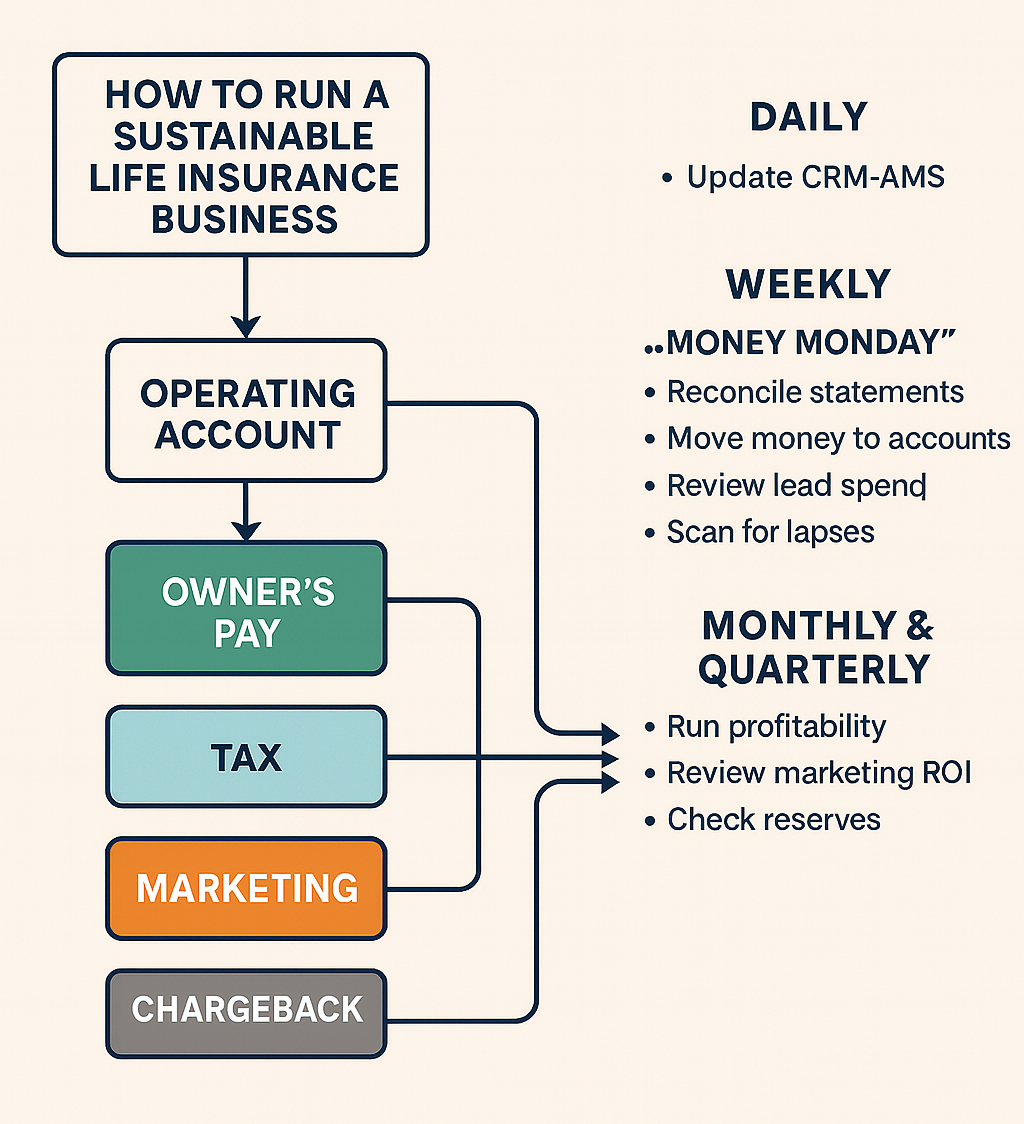
"Infographic of a money flow system for life insurance agents. Commissions flow into separate accounts: Operating, Owner’s Pay, Marketing, Chargeback Reserve, and optional Tax account if not using payroll. The chart also shows business rhythms: Daily CRM-AMS updates, Weekly ‘Money Monday’ allocations, and Monthly/Quarterly reviews of profitability, marketing ROI, and reserves. Designed to help agents run a sustainable, stress-free business."

  • Owner’s Pay – 30%
  • Taxes – 25% (skip this if you’re on payroll)
  • Marketing – 15%
  • Operating – 15%
  • Chargeback Reserve – 10%
  • Buffer – 5%

As you stabilize and your persistency improves, you can bump Owner’s Pay up a bit.

The real key here is predictability. With payroll, you set your own “salary floor” and then pay yourself quarterly bonuses if your rolling average allows. That steadiness kills 90% of the anxiety in this business.


Always Fund Marketing (Even on Bad Weeks)

Marketing is oxygen. When times are tough, the worst mistake you can make is cutting lead flow. That’s how agents spiral out.

Decide on a weekly marketing budget as a percentage of your net commissions, and stick to it—rain or shine.

A good split looks like this:

  • 70% proven channels
  • 20% testing new sources
  • 10% long-term branding (relationships, community, centers of influence)

This balance keeps your funnel alive without chasing shiny objects.


Daily, Weekly, Monthly: Your Business Rhythm

The agents who thrive treat their business like a business. That means daily habits, a weekly rhythm, and a monthly/quarterly review. Let’s break it down:

Daily – The 15-Minute Discipline

Every night, update your CRM-AMS:

  • Add new leads, clients, policies, recruits, and agents.
  • Update status changes (set, sat, sold, pending, issued, charged back).

This takes 10–15 minutes but keeps your business visible and under control. You can’t fix what you don’t track.

Weekly – “Money Monday” (90 minutes)

Block out time every Monday to:

  1. Reconcile your carrier statements.
  2. Move money into your accounts.
  3. Review lead spend and appointments for the coming week.
  4. Scan for upcoming chargebacks or lapses.

Same time, same day, same process. Do this, and you’ll save yourself a hundred little panics.

Monthly & Quarterly – The Big Picture

At the end of every month:

  • Run profitability by product/carrier.
  • Review marketing ROI.
  • Check how many weeks of expenses your reserves cover.

At the end of every quarter:

  • Verify your tax set-aside or payroll withholdings.
  • Adjust allocation percentages if needed.
  • Refresh your annual goals and budgets.

These rhythms keep you in control instead of reactive.


What To Do When Trouble Hits

Every business hits bumps. The key is knowing what to do when—not reacting emotionally.

Here’s your stabilization plan:

  1. Cut non-essentials first (subscriptions, perks).
  2. Protect lead flow—never starve your pipeline.
  3. Check your runway—how many weeks of expenses your reserves cover.
  4. Pull the three levers: increase activity, focus on larger cases, conserve inforce policies.

Do this, and you’ll outlast 90% of the noise.


Final Word

Here’s the truth: selling life insurance can make you wealthy, but running your insurance business like a business is what makes you sustainable.

If you set up multiple accounts, automate your payroll and taxes, update your CRM-AMS daily, and follow your weekly and monthly rhythms, you’ll never again wonder where the money went or why the stress is eating you alive.

Build the system now, and you’ll have a foundation strong enough to weather any storm. That’s how you get peace of mind—and sleep at night.


Your Clients May Be in Lock-In. That Does Not Mean You Have to Be.

Your Clients May Be in Lock-In. That Does Not Mean You Have to Be.

Your Clients May Be in Lock-In. That Does Not Mean You Have to Be.

There is a temptation that shows up every year around this time, and if we are honest, most agents feel it.

The noise of OEP fades. The urgency slows down. For those who built much of their activity around Medicare Advantage, the lock-in period begins, and with it comes a subtle but dangerous thought: Maybe this is just a slower season.

That thought may seem harmless, but it has a way of doing real damage. Not because it is always spoken out loud. Most of the time it is not. It simply settles into the habits of an agent who starts making fewer calls, having fewer conversations, and convincing himself that the calendar is quieter because the market is quieter.

It is not.

At least, it does not have to be.

One of the mistakes agents make in this business is assuming that if a client cannot make one kind of change right now, then there is nothing meaningful to talk about. That is rarely true. In fact, it is often the opposite. When a Medicare client is in lock-in, that may be the perfect time to step back and ask a better question.

Not, “What can I move today?”

But, “What have we not reviewed in a while?”

That is a very different mindset. It is also a much healthier one.

Good agents do not build their business only on transaction windows. They build it on relationships, stewardship, and the discipline of staying close enough to their clients to see what has changed. A locked-in policy does not mean a locked-in life. The policy may be staying put for now, but the client’s world may have changed in ways that matter far more than the policy itself.

Maybe they have taken on more debt. Maybe a spouse still has no coverage in place. Maybe an adult child now has a family of his own and has never sat down with anyone to talk through what protection looks like. Maybe the beneficiaries listed on an existing life policy have not been revisited in years. Maybe a client who once said, “I think I am okay,” is no longer okay at all.

This is why policy reviews matter.

And this is also why April can become an important month for the right kind of agent.

The wrong kind of agent sees lock-in and assumes the opportunity has dried up. The right kind of agent sees lock-in and realizes that the distraction of constant plan movement has quieted down enough to make room for deeper conversations. Conversations that often should have happened sooner.

I say that because too many agents treat the sale as the end of the process. It is not. The sale is often the beginning of the real work. Once a client trusts you, once your name is attached to a policy, once you have earned the right to be heard, you are in a position to do more than service a contract. You are in a position to help someone think more clearly about the people they love, the responsibilities they carry, and the risks they may still be ignoring.

That is not a small thing.

And it should not be rushed past.

This is where life-focused agents have an advantage too, assuming they are willing to use it. Even if your book is mostly built around life sales rather than Medicare, the same principle applies. One of the most important questions an agent can ask is this: When was the last time this policy was truly reviewed?

Not looked at. Not mentioned in passing. Not assumed to still be “fine.” Reviewed.

A client’s life can change dramatically in a year or two. Mortgage balances change. Income changes. Health changes. Families grow. Businesses open and close. Children become adults. Parents become dependent. Inflation quietly turns an amount that once felt meaningful into something much less protective than it seemed when the application was signed.

That does not mean every review results in a new sale. It should not. But it often results in clarity. And clarity has a way of opening doors.

Sometimes that door leads to a Final Expense conversation for an older client who never really solved the problem they thought they solved. Sometimes it leads to a Term conversation for a younger family whose responsibilities have grown faster than their coverage. Sometimes it leads to Mortgage Protection for a homeowner who has never seriously considered what would happen to the house if income disappeared.

None of those conversations should feel forced. They are not manufactured needs. They are needs that were either overlooked, postponed, or changed by life itself.

And then there is the second layer, the one many agents miss.

A good review should not only help you see the client more clearly. It should help you see the people connected to that client.

This is where activity begins to multiply.

If you are reviewing a client’s situation and talking through beneficiaries, family responsibilities, and future concerns, you are already standing at the edge of a much broader conversation. Who else in the family should have a review? Does the spouse have proper protection? What about the adult children? What about parents who may still need Final Expense planning? What about a co-borrower, a business partner, or someone who has been listed as a beneficiary but has never once sat down to think about his or her own protection needs?

Those are not awkward questions when trust already exists. They are often the most natural questions in the room.

And that is one of the great missed opportunities in our business. Too many agents look at their book as a list of completed transactions. The better way to see it is as a network of relationships. A living, breathing collection of households, stories, responsibilities, and unfinished conversations. If you approach your book that way, you begin to realize something important.

Your book is probably bigger than you think.

Not because the number of names on the page suddenly changed. But because every client tends to be connected to other people who may need help, and those conversations are far easier to begin when they grow out of service, care, and thoughtful review.

This is also where discipline becomes a business issue.

There is nothing wrong with buying leads. Most growing agents will need leads at some level. But I have seen too many agents spend money looking for more strangers while leaving too much opportunity untouched inside the relationships they already have. That is not always a lead problem. Often it is a stewardship problem.

Before we assume we need more leads, we should probably ask whether we have fully worked the book we already own.

Have we called the clients we have not spoken to in a while? Have we reviewed the policies already on the books? Have we asked about the spouse, the beneficiary, the children, the parents, the mortgage, the business, the changes that life tends to introduce quietly when nobody is paying attention? Have we created enough activity from trust before deciding the only answer is to go buy more cold opportunity?

Those are not comfortable questions for every agent. But they are healthy ones.

Because a professional does not wait for the perfect season to become productive again. A professional learns how to create momentum from the ground already under his feet. That is how you build a real business, not just a book of past transactions.

That is what April can be.

It can be the month you drift because OEP is over and the energy changed.

Or it can be the month you become more intentional. The month you stop seeing policy reviews as administrative tasks and start seeing them as one of the purest forms of service an agent can provide. The month you realize that asking better questions inside your current book may do more for your business than another rushed round of lead spending ever will.

That may sound simple. In some ways, it is.

But simple does not mean easy.

It takes humility to go back through the book carefully. It takes discipline to make calls when there is no manufactured urgency. It takes maturity to build a business around relationships instead of adrenaline. And it takes the heart of a true advisor to understand that some of your best opportunities will not come from chasing the next new name, but from serving the people who already know and trust you. That kind of mentorship and intentional growth is what separates professionals from salespeople who are always waiting for the next rush.

So yes, your Medicare clients may be in lock-in.

But that does not mean you have to be.

This is still a good month to review. A good month to ask better questions. A good month to revisit life policies that may no longer fit the realities they were meant to protect. A good month to talk about beneficiaries, family members, and the people who may still be exposed. A good month to uncover needs that were never fully addressed the first time.

And maybe most of all, it is a good month to remember that a healthy book of business should do more than sit there.

It should speak.

The question is whether we are listening closely enough to hear what it is telling us. And when you need the structure, tools, and support to keep serving clients well, that is exactly why the right systems matter.

Image

Address

Legacy Agent, LLC
5119 Highland Rd. Ste 271
Waterford Twp, MI 48327
 

Talk to us

+1-888-479-9888
+1-248-461-3360
BBB
google-site-verification: google6e400572aab2e7f0.html